
Legal assistance in criminal proceedings may be obtained by contacting the person conducting the criminal proceedings (police officer, judge, prosecutor) by a person who has been recognized as a victim in the criminal proceedings and by a person who has the right to legal representation in the cases and in accordance with the procedures set forth in the Criminal Procedure Law.
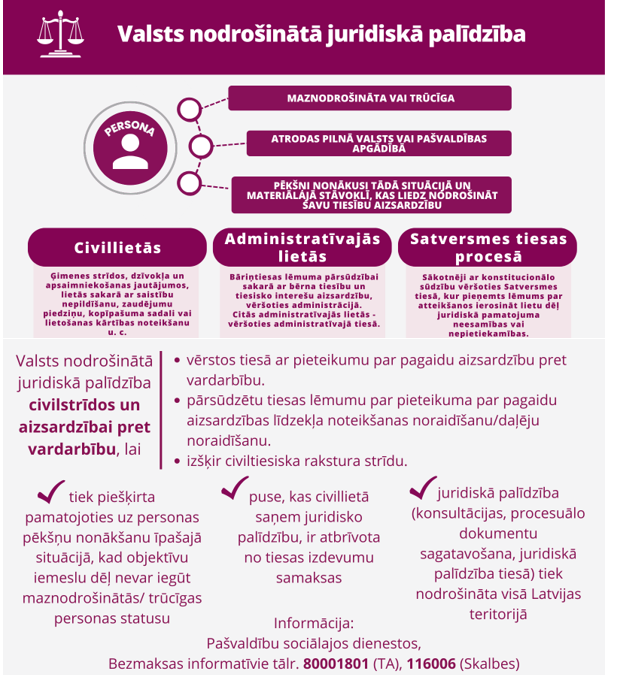
By contacting the administration, legal aid for the resolution of civil disputes, certain types of administrative cases, and proceedings before the Constitutional Court may be obtained by a person* who:
- has been granted the status of a low-income or low-income household (as evidenced by a certificate issued by the Social Services; to obtain this, one must apply to the Social Services office in their place of residence);
- has suddenly found themselves in a situation and financial circumstances that prevent them from ensuring the protection of their rights (due to natural disasters, force majeure, or other circumstances beyond the person’s control, such as in cases of violence);
- is fully dependent on state or municipal support (as confirmed by a certificate issued by the head of the relevant agency).
Partial state-provided legal aid for certain types of attorneys in civil proceedings (within the jurisdiction of the Economic Court, arising from contract law, where the amount in dispute exceeds 150,000 euros, regarding the protection of trade secrets against unlawful acquisition, use, and disclosure) may be received by persons:
- whose income level does not exceed the minimum monthly wage set by the state;
- whose financial status qualifies them for legal aid.
Whistleblowers are eligible for state-provided legal aid regardless of their financial status. More: State-provided legal aid for whistleblowers
* State-provided legal aid may be received by a Latvian citizen, a non-citizen of Latvia, a stateless person, a citizen of the European Union who is not a Latvian citizen, but who are legally residing in the Republic of Latvia, and foreigners (including refugees and persons who have been granted subsidiary protection status in the Republic of Latvia) who are not citizens of a European Union member state, provided they are legally residing in the Republic of Latvia and have received a permanent residence permit.
Cases in which state-provided legal aid may be obtained:
- In civil cases for the resolution of specific civil disputes, to bring a case before a court and in civil cases until the final court decision enters into force. (https://www.ta.gov.lv/lv/civillietas);
- In administrative cases (https://www.ta.gov.lv/lv/administrativajas-lietas):
- In the process of appealing a decision of the Orphan’s Court regarding the protection of a child’s rights and legal interests
- In complex administrative cases.
- Appeals in the asylum granting process
- In the process of deporting foreigners
- In proceedings before the Constitutional Court (https://www.ta.gov.lv/lv/satversmes-tiesas-procesa):
- The state provides legal aid in proceedings before the Constitutional Court if a person has filed a constitutional complaint (application) with the Constitutional Court and the Constitutional Court has issued a decision refusing to initiate proceedings, citing as the sole basis for this decision the absence of legal grounds or their obvious insufficiency to satisfy the claim.
- In criminal proceedings (https://www.ta.gov.lv/lv/kriminalprocesa
-
- Ensuring the right to defense in criminal proceedings;
- Victims requiring special protection.
5. Whistleblower (https://www.ta.gov.lv/lv/trauksmes-celejam)
More info: https://www.ta.gov.lv/lv/valsts-nodrosinata-juridiska-palidziba